What sets The Spec Hub apart
We spec for risk elimination and mitigation — not to sell a specific product.
Most roof access businesses start with a product. They represent a brand, or a family of brands, and the design process works backwards from what they can supply. The question becomes "Which of our systems fits this roof?" instead of "What is the actual risk on this roof, and what is the best way to deal with it?"
The Spec Hub starts with the risk. We look at the building, the work that will happen on it (or need to happen to it), and the people who will do that work. Only after the risk is understood do we look at product options — and that includes options that change the building so the risk doesn't exist in the first place.
That risk-first mindset is not new for us. It is the foundation Robert has worked from for more than 20 years in this profession. It has been refined through the completion of over 3,000 roof and facade access designs, and it is now built into every specification The Spec Hub delivers.
Our approach: D.R.E.A.M
We use a simple framework to keep every project honest. It stops us from defaulting to a product before we have earned the right to recommend one.
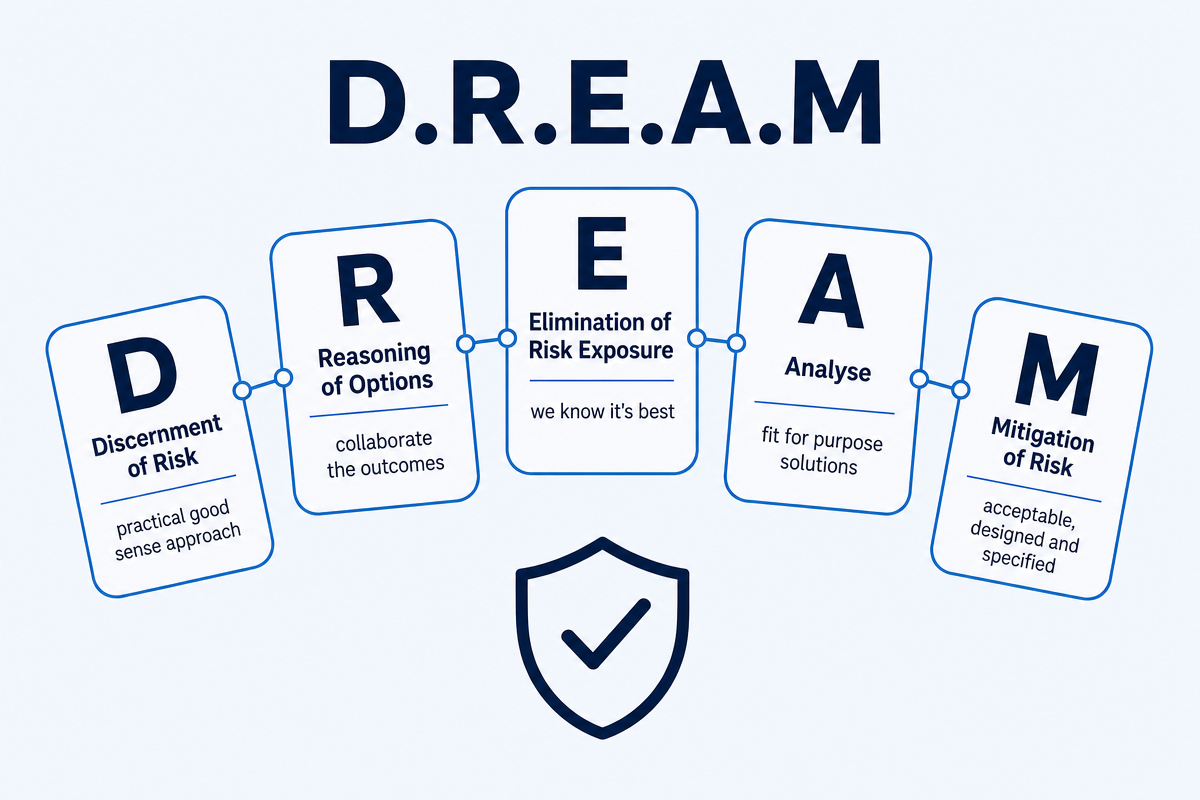
Hover or tap a letter in the diagram above to read what each step means.
Risk first, product second
Every specification we write follows the hierarchy of controls. The first question is whether the access can be eliminated or reduced by design. Can the plant be moved to ground level? Can the roof pitch be changed so no one needs to walk it? Can the facade element be maintained from inside the building? If the answer is yes, we say so — even when it means telling the builder to change the build.
When access cannot be eliminated, we work down through isolation, engineering controls and administrative controls before we settle on personal fall-arrest. That is not because fall-arrest is wrong; it is because it should be the last stop, not the first.
No hardware bias
We are not tied to a manufacturer. We do not carry stock, we do not earn margin on product sales, and we do not have a quota to meet. That means the specification can genuinely choose the right control for the risk, not the right risk for the product.
Installers still matter. A great design that no one can install well is not a great design. So we keep the specification connected to a qualified installer network and make sure the installed system is the system that was specified.
We will change the build to eliminate the risk
Sometimes the cheapest and safest thing is not a piece of height safety equipment at all. It is a design change. We will tell a builder when a small change to the architecture, services layout or maintenance strategy removes (or reduce significantly) the need for roof and/or facade access entirely. That is not always popular, but it is always honest — and it is usually the most defensible position under the WHS Act.
Aligned to the designer's duty
Under the WHS Act, designers of structures already have a duty to consider health and safety in their designs. The Spec Hub is built to help architects and designers discharge that duty with a clear record: risk assessment, hierarchy-of-controls reasoning, product options considered, and a final specification with justification.
What the client receives
- —A risk assessment specific to the building and the work, starting with the free Height Safety Design Assessment tool.
- —A specification written to AS 1657 and AS/NZS 1891 where relevant.
- —Written reasoning where a lower-order control is proposed.
- —A design report and Statement of Design Compliance that can sit in the WHS file and be handed to a certifier or installer.
- —Optional access to a qualified installer network that understands the specification.
Questions? Email admin@f4ps.com.au or use the C.A.S.S Assessment on the Spec Hub page to submit a project for review.