Powder coating an aluminium walkway: does it void the slip rating?
A practical note on why coating a walkway can quietly undo the very thing it was specified for.
Short answer
Yes, it can — and it often does, unless the coating has been specifically accounted for in the slip-resistance rating.
Why it happens
Most aluminium walkway surfaces get their slip rating from the mechanical texture of the metal itself — the raised diamond pattern, serrations, or perforations that make up the tread. That texture is what gets tested under AS/NZS 4586 to produce a P classification, and AS 1657 leans on that classification when it asks for a walkway surface to be "slip-resistant".
Standard powder coating is a smooth, hard polymer film. When it is applied over a textured tread it can fill in or round off the fine edges that generate the grip, and it can leave a glossy or satin finish that behaves very differently underfoot when wet. The original slip-resistance certificate was for the uncoated surface as tested, not for the coated surface that ends up on site. So once it is coated, the original classification may no longer apply — not because powder coating is banned, but because the tested article and the installed article are no longer the same thing.
The test that matters
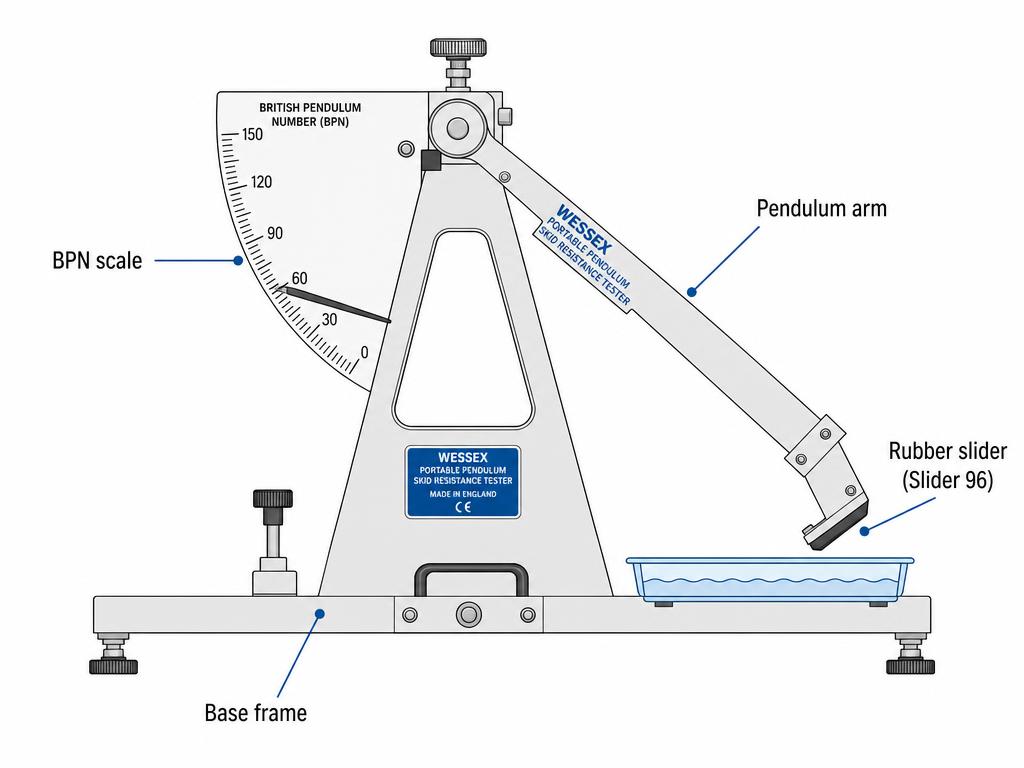
The P classification comes from a wet pendulum test under AS/NZS 4586 Appendix A. A portable British pendulum tester swings a rubber slider across a wet surface and reads a British Pendulum Number (BPN). That number converts to a P class: P5 (>54), P4 (45–54), P3 (35–44), P2 (25–34), P1 (12–24), P0 (<12).
The device is portable, which means it can be used in a lab on a new product sample and also taken to site to test an installed or existing surface. That is important: a walkway that was rated before coating may not test the same after coating.
What classification should a walkway aim for?
AS 1657 does not state a single P or R class in the standard text itself. It requires the surface to be slip-resistant, and the target class is usually drawn from HB 198 based on the expected environment and use. For aluminium walkways, the table below is a reasonable starting point for discussion.
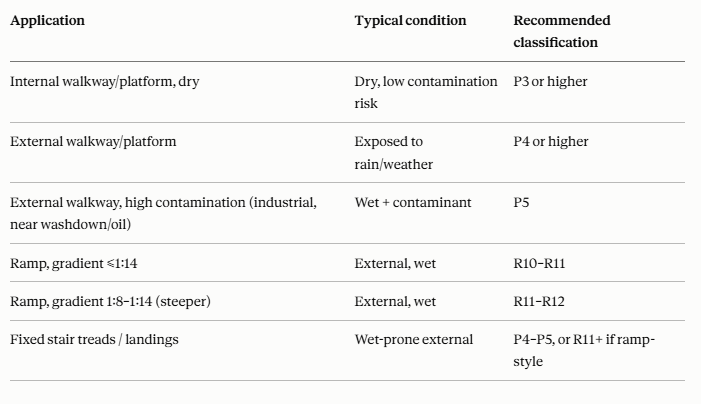
A few things worth keeping in mind: P-classification is from the wet pendulum test and is the one most relevant to flat walkways and platforms. Higher numbers mean more slip resistance. For an external aluminium walkway exposed to rain, P4 is commonly discussed as a baseline target.
How people avoid the problem
- —Use a purpose-made textured or anti-slip powder coat. Aggregate-loaded formulations exist for this, and some are supplied with their own AS/NZS 4586 classification.
- —Get the coated assembly re-tested by a NATA-accredited lab if you need a defensible classification for the finished product.
- —Leave the functional tread pattern uncoated or masked and only coat the structural members, if the design allows it.
Practically speaking
If this is for a real project, ask the powder coat manufacturer for a slip-resistance classification of the coated product, not just the bare aluminium substrate. Reputable suppliers will have this if the product is rated for walkways. If they cannot provide it, that is a sign it has not been tested that way and you are relying on an assumption rather than a certificate.
If you are not sure whether your specific surface will survive coating, send us the details — diamond-pattern tread plate, mesh grating, and flat plank with applied anti-slip strips all behave differently once coated.